
Last month, the Supreme Court decision in Mullin v. Doe allowed the Department of Homeland Security to end Temporary Protected Status for Haitians and Syrians in the United States. This decision means that more than 300,000 Haitians could be vulnerable to deportation, starting in the next few weeks. Work authorizations for those on Temporary Protected Status (TPS) could end as soon as next week.
This chaos and instability for families who have come to the United States seeking stability and safety has, sadly, been the norm for the past year.
The U.S. House of Representatives passed a bill that would extend TPS for three more years, until 2029. The bill went to the U.S. Senate a week before the Supreme Court ruled in Mullin v. Doe. The United States Conference of Catholic Bishops has shared a link to write to your senator urging them to pass the bill (S. 4814).
You can access this link here.
If you would like to learn more about the conditions in Haiti, we have shared two pieces below, one James wrote a year ago, the other our friend M. shared with us earlier this year.
Please pray for our Haitian friends and neighbors. If you would like to offer concrete help to Haitian families here in Harrisburg who are working hard to provide their families with a better life, please write to [email protected]. The need is abundant and the laborers are few, so pray for the Lord of the harvest to send out laborers into the harvest!

Haitians in Harrisburg are Stuck
By James Murphy
from the August-September 2025 issue of The Personalist
We have met many wonderful Haitian families in our neighborhood and have become friends with quite a few.
Inevitably, many conversations revolve around the bleak updates for humanitarian parole and Temporary Protected Status for Haitians. On June 12, 2025, the Secretary of the Department of Homeland Security (DHS), Kristi Noem, terminated the CHNV program offering humanitarian parole for Cubans, Haitians, Nicaraguans and Venezuelans.
Two weeks later, DHS announced that Temporary Protected Status (TPS) for Haitians would expire in early September. After an agonizing few weeks, a court ruling extended TPS until February 2026.
More than 500,000 Haitians currently living in the United States are at risk of being deported, including an estimated 10,000 to 15,000 Haitians in the Harrisburg area.
They will also lose their work authorizations, which will force many to lose their jobs which pay for the shelter and living expenses for them and their children.
Many employers fired Haitian employees after the June TPS announcement and, although the program remains intact until February, they have not hired them back. According to the DHS press release, “The environmental situation in Haiti has improved enough that it is safe for Haitian citizens to return home.”
The statement claims Secretary Noem made this decision with input from other agencies, including the US Department of State: “The Secretary determined that, overall, country conditions have improved to the point where Haitians can return home in safety,” the DHS press release announcing this
decision stated.
Yet the US Department of State currently marks Haiti with a Level 4: “Do Not Travel” advisory on its website. A Level 4 travel advisory is the highest travel
warning issued by the State Department. On June 24, the United States Embassy to Haiti posted on X (Twitter) telling Americans not to travel to Haiti, and warning Americans who were in Haiti to leave. “Do not travel to Haiti due to kidnapping, crime, civil unrest, and limited health care,” they warned. “Kidnapping is widespread.”
A three-year-old child and seven staff members were kidnapped at an orphanage outside Port-au-Prince on August 3. Does this sound like a safe place to you?
This advisory does not reflect only dangers for foreign travelers. Many Haitians in Harrisburg have shared stories of family members kidnapped, homes burnt to the ground, sexual violence, and murdered family members. To live in Haiti is dangerous and life-threatening for Haitians as well as visitors right now.
The violence and political instability have brought in their wake food insecurity, hospitals shuttering, and schools closed indefinitely. We have met Haitian families with young children who are thriving in the United States, while in Haiti, 22% of children under five years of age are chronically malnourished, and a significant percentage suffer from acute malnutrition.
Budget cuts to agencies like USAID have only made the problem worse. Families returning to Haiti face food insecurity and limited access to quality education. Haiti is not a place right now where Kristi Noem or Marco
Rubio would send their own children. So why are they sending Haitian children to face malnourishment and death?
In May 1939, the German liner St. Louis sailed from Germany to Cuba. The 937 passengers were almost all Jewish refugees. Cuba’s government refused to allow the ship to land. The United States and Canada were unwilling to admit the passengers. The St. Louis passengers were finally permitted safe passage to Belgium, France and England, rather than return to Nazi Germany. Ultimately, 254 St. Louis passengers were killed in the Holocaust.
TPS was created to save lives, and avoid tragedies like the 254 murdered German-Jews aboard the St. Louis. If we are to send people back to Haiti, we are sending some back to their deaths, others, including children, will lack food and education. Parents will be stripped of the dignity of legally working in the United States and will lack employment and hope of supporting their families after being deported to Haiti.
As a nation, we are repeating the same crime the United States committed in 1939 with the passengers aboard the St. Louis. For decades, American Christians fought to overturn Roe V. Wade in order to save the lives of the helpless innocent. Will American Christians now stand by and allow our 500,000 new Haitian neighbors to face violence, death, and hopelessness? Will we send children to places we would never dare send our own?

Flight from Haiti: M’s Story
As told to James and Renée
I was born in Port Au Prince, Haiti. I grew up going to a Christian elementary school. I lost my mother as a young child, and my father died when I was 12 years old. In 1991, a coup d’état removed Haiti’s democratically elected president, Jean-Bertrand Aristide, a former Catholic priest. It was a very difficult time for me. President Aristide was eventually reinstated and deposed again in 2004. There was a lot of political instability after that. In my high school, I learned how to cut hair; I took painting, I learned sculpture. I managed a living with these artistic skills.
My first son was born in 2008. He lives in Haiti still. In 2010, I was 20 years old when the earthquake struck Haiti. three-hundred thousand people died. I was lucky. When the earth began to tremble, I was outside painting a mural on a wall. This saved my life. After the earthquake, I earned my living by cutting hair. Four years later, in 2015, we had the first election in Haiti since the earthquake. I backed a candidate who did not win. But otherwise, things were going well for me. I married my wife, M, in 2017. And our daughter was born later that year. We opened up a beauty salon together, and we had a little bit of savings, too. Life was prety good.
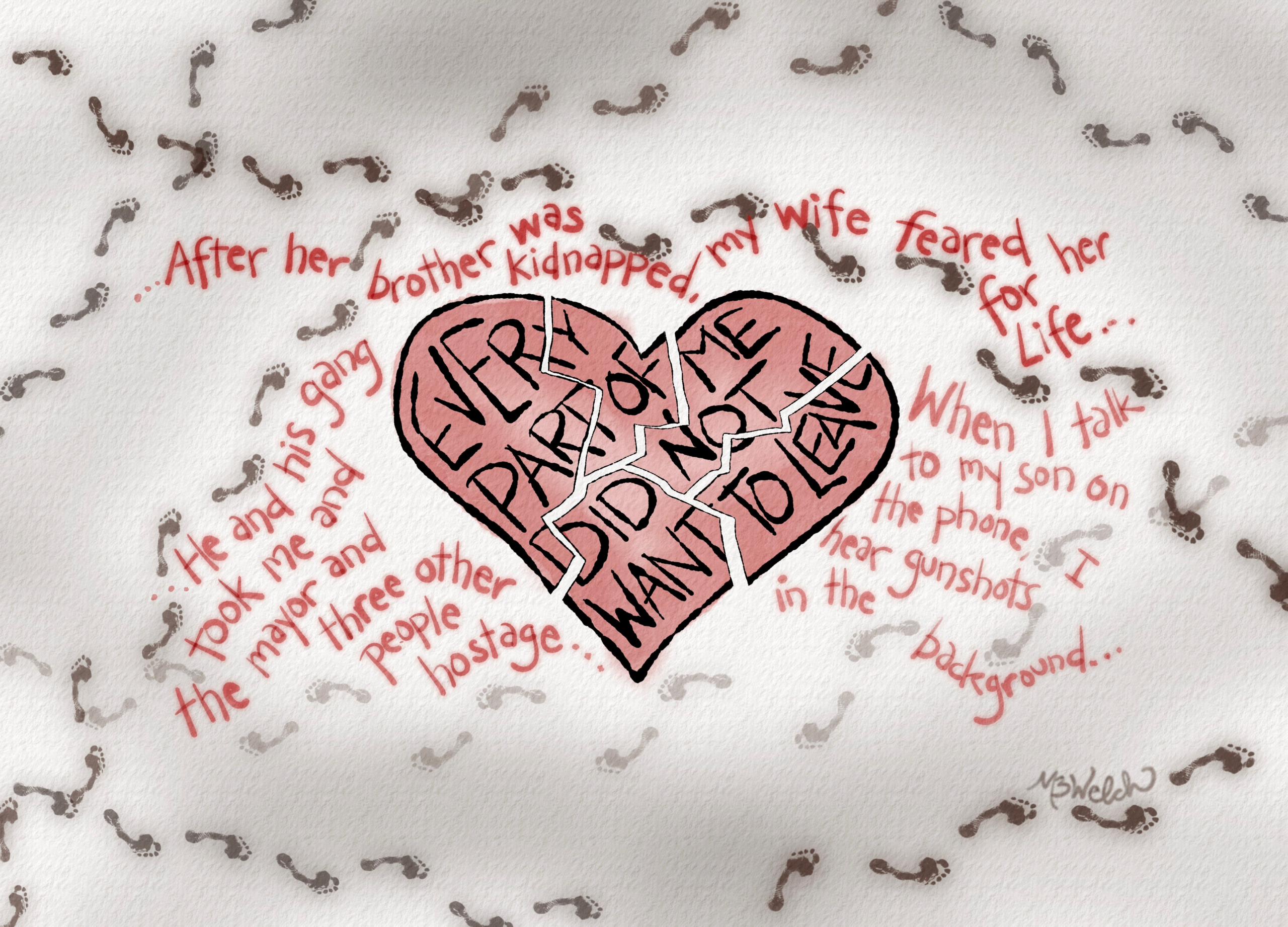
I began working with a woman mayor of a town not far from Port-au-Prince. My art had political messaging in it in support of this mayor. My colleagues and I suspected a local commissioner of corruption. This commissioner did not appreciate the policial messageing or our suspicions. He and his gang took me and the mayor and three other people hostage. We were held for several hours in a cabin before we were thankfully released. So I left this job and went back to Port Au Prince. I continued to make political messages on T-shirts. Tèt Kale Party— PHTK—operatives followed me. They called me a menace. After I did an interview about the situation with a local newspaper, these operatives began to show up at my house every single day. My wife was very afraid. She was scared for me—she told me I had to leave the country to be safe. Every part of me did not want to leave, but I took the advice of my wife and my little sister and took a plane to Suriname, on the northern coast of South America.
It was a terribly difficult time for me. It reminded me of how I felt when I was orphaned at age 12. I lived in a very difficult environment in Suriname, a shantytown. It was unstable. If someone was angry with you, they would set fire to your shack. Suriname became unbearable and I moved to Guyana where at least I could speak French. Everywhere I have gone, Haitians are targeted and racism is directed toward us.
In Guyana, I continued to cut hair to feed myself. At this time, President Biden opened up TPS and the CNHV program for Haitian nationals to find asylum in the United States.. Haiti was a mess and these programs saved lives. My wife had gone out to live with her family in a very poor area of Haiti. It did not go well for her, so she and my daughter went back to live with her brother, at the studio my wife and I started in Port Au Prince. A
fter her brother was kidnapped, my wife feared for her life. Her cousin in New Jersey and her brother in Miami sponsored her in the United States. My wife came to Miami in January of 2024. “I’ll meet you in the United States,” I told her. So I began my walk from Guyana. I took the Pan American Highway and walked. I left Guyana on January 15, 2024. I arrived in Mexico City on March 8.
I left Guyana with a group of five people. By the time we reached the Darien Gap, on the border of Panama and Colombia, I was with a group of 2,000 people. The whole trip from Guyana to Mexico City cost me 5,500 Euro, which is what they use in Guyana, roughly $6,000. The journey through the Darien was horrible. I don’t want to think about it. We didn’t have water bottles; we drank water from the ground. When I arrived in Mexico City, I downloaded the CBP One that President Joe Biden created for asylum seekers to create border crossing appointments.
I spent seven months in Mexico City. I cut hair, and my family sent me money to support me. I got my appointment on the CBP One app and, soon after, I walked and caught rides on motorcycles for three days to the frontier at McAllen, Texas. I had to be careful, as some motorcycles said they would take you, but would drive you to the Guatemala border instead.
I finally entered the United States on November 18, 2024. I flew from Texas to Harrisburg, where my wife was living. She came here because she had a cousin here. She had a job and was renting a room. Since I left Haiti, the country has gotten worse. Gangs have taken over after the assassination of Moïse. Anyone who comes back from the United States is a target for extortion by gangs. When I talk to my son on the phone, I hear gunshots in the background.
It’s safer here in the U.S. We can go to school I would love to go back to Haiti. If that is what it comes down to, I’ll do it, but I wish I were returning to a stable country, a country with justice and stability and security. I am less concerned about myself than I am for my nine-year-old daughter. I do not want her to have to return to Haiti and see her raped or killed in front of me.