
By James Murphy

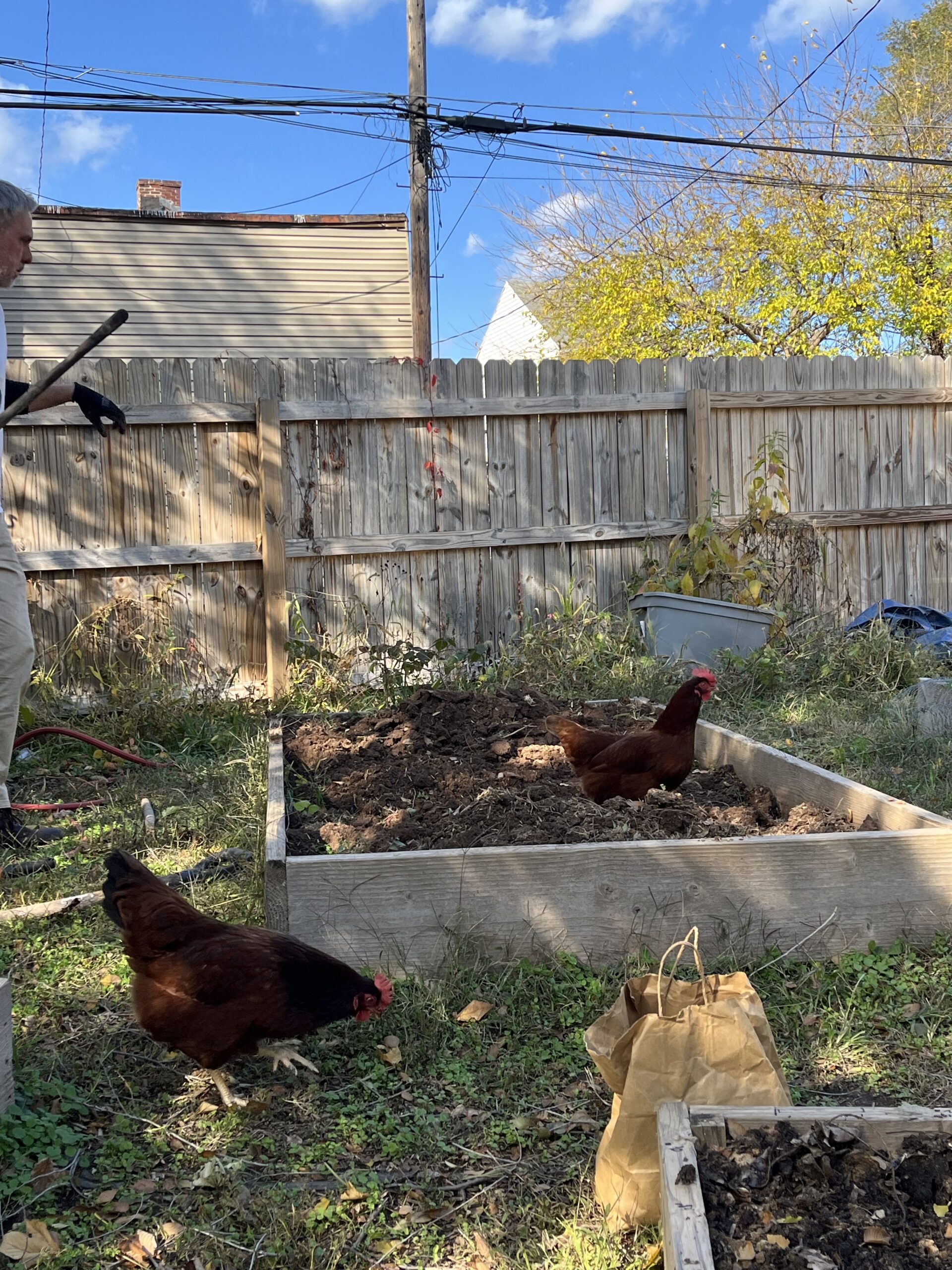
The Notre Dame Alumni Club of Harrisburg has helped the Catholic Worker buy soil for our garden beds the past two years. Good soil is not cheap, and because we built taller garden beds this year to discourage groundhogs, we need more soil to fill the beds. Crops deplete nutrients from the raised beds, so our soil requires regular nutrient replenishment.
Mama Mary Farm strives to be 100% organic, so, without a lot of money, we need to get creative in order to replenish the nutrients in our soil. We have some nice open-top wooden composting bins in our garden where we have been disposing of our food scraps and other organic material. We also created leaf mulch from last year’s fallen leaves. And, this past year, we have been piloting a composting method that can be done indoors.
The technique is known as the Bokashi method. It has become our main method of composting at the house. While traditional outdoor composting can take several months, the Bokashi method can turn food scraps into healthy soil in a matter of weeks.
The Bokashi method ferments the scraps (or pickles) the food scraps into a “pre-compost.” The Bokashi method requires two ingredients: first, a product called “Bokashi bran.” Bokashi bran contains beneficial micro-organisms that ferments food scraps into a pre-compost that can be used as a soil conditioner. Second, the bokashi process requires an oxygen-free (anaerobic) environment in which the fermenting process can take place at room temperature.
At the Catholic Worker, we have been using airtight five-gallon buckets and layering our food scraps along with the bokashi bran into the sealed buckets. Like traditional composting methods, we throw in fruits, veggies, coffee grounds, tea bags, and cooked foods like bread and pasta. Additionally, Bokashi bran is even powerful enough to break down cheese, eggs, meat, fish, and small bones. The food scraps are not usually composted in outdoor bins because of the foul odors they create and the pests they attract. The only scraps we exclude from the Bokashi bins are liquids like spoiled milk, oil or cooking grease.

We love using the Bokashi method for a variety of reasons. First, we can compost inside. The anaerobic environment in the buckets keeps the process odorless as the food scraps ferment. We also love Bokashi, because the composting process is faster and more efficient than taking food out to the composting bins outside. Once we have filled a bucket with layers of food scraps and bran, we close the bucket and let the mix ferment for two weeks. Once the fermentation process is complete, we bury the precompost in soil in our raised beds. After 4-6 weeks, the soil is ready for planting. From food scraps on our table to planting, the whole Bokashi process of composting takes under two months.
The Catholic Worker has also been providing a Bokashi composting system to the St. Francis of Assisi Soup Kitchen since July. We have been hauling away about 40 gallons of pre-compost from the soup kitchen each month since. The soup kitchen is not only feeding the hungry in the neighborhood, but also feeding our garden and replenishing the soil. The Bokashi method has reduced the Catholic Worker’s and soup kitchen’s food waste to nearly zero, while producing nutrient-rich, organic soil for the garden.
Which brings us to another reason we like using Bokashi: Food waste in landfills is the third largest man-made producer of methane gas after the oil and gas industries and industrial agriculture. Methane is a potent greenhouse gas that significantly contributes to climate change by trapping heat in the atmosphere and warming up the earth. Even traditional outdoor composting produces methane. Bokashi, on the other hand, produces almost no greenhouse gas emissions during the process, making it a more environmentally-friendly method.
We are delighted to find a composting system that puts our food waste back into the soil in just a few weeks. The Bokashi process uses our food waste to nourish the earth, making growing food easier, rather than contributing gases that warm the earth, making food production increasingly difficult and more precarious. Bokashi bran and indoor composting systems can be purchased online and found with a quick digital search. You can also easily make your own bokashi bran and indoor systems with a little bit of elbow grease! We make our own Bokashi bran and also our bucket systems.
If you want to learn more to make or purchase your own system, the Harrisburg Catholic Worker will be hosting a basic introduction to the Bokashi composting method on Sunday, March 29 at the St. Martin de Porres House at 4:00 p.m. (1440 Market Street). Please join us and learn how you can introduce this to your home, parish, school or work place!
